
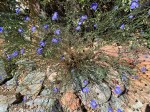

A flash of red catches the sun, sending a jet of energy into the solitary soul as they sit staring into the desert morning. Pale blue flax flowers dot the near landscape, drawing the creatures with their brilliant colors and sweet nectar. A flash of turquoise joins the ruby and a delicate dance ensues as the two colors battle for each bloom, even though the desert is full of options to choose from. They both rise almost as one, disturbed by the sudden discovery of the nearby watcher. They both hover for a moment above the blossom carpeted desert floor, sparkling green and red as the sun catches the underside of their wings, simultaneously before they zip away in search of a more isolated feeding ground.
Dear Annalis,
I know this may seem like I am relating a dream, but his is how I started my morning today here at the studio. I can only compare these desert dwellers to the earthen hummingbirds, but they do have distinct differences. Of course the European hummingbird have long ago disappeared from the continent, but I have seen the honeyeaters during my time in Australia and the hummingbird during the few weeks | spent in Ecuador for research. You can imagine my elation the first time these visitors arrived outside my studio window to feed off the prolific flora that arrives here after the desert storms.
In my vision they are a cross between the South American hummingbird and the Australian honeyeater. They are slightly larger than the South American species, but with the beak of the honeyeater. The coloring matches more to the hummingbird, but the brightest colors are under the wings and not the throat. They have a strange pattern on the top of their wings that becomes a diamond shape when they are in flight. The locals call them rumor or murmur birds after the sound of their fast beating wings. When I first encountered them last spring, I thought a large group of gnomes were all huddled in the garden surrounding my studio and they were whispering to each other: A conspiracy of fairies. It was unnerving at first until Katryna told me what they were. I now see them out early in the morning most days. Their presence seems to energize me. I cannot help wondering if the Moramets, once they are established on the planet, will cohabitate with these wonderful flyers. As I described, they can be quite competitive for sustenance. I am sure the research team of your professor Simona will have delved into this particular subject before the decision was made to relocate them here.
I have now started work on the follow up rendition and it is going well. The recovery from my time at the remote station has been slow, but with your arrival finally at the Phycodurus and my return to the full Equine exposure, I feel I am up for the challenge. I still have not heard from Katryna, but Addison spends a day every week helping me out around the studio to maintain all is in working order. This allows for some much needed social interaction and also during my frequent travels into the village.
I have also made contact with Nikolas’s. This time he is coming to me. His endeavors in the north are going splendidly and he wants to study some of the southern plant varieties to incorporate them into his dishes. Next month we will meet in Newton to visit the tea shop where I told you I met the local herbalist and purchased the book she authored. She has agreed to present a short two day seminar for the two of us on the botanical world of New London. Then Nicolaas and I will travel back to my studio to spend a few weeks studying and experimenting with the local desert edibles available in this area. I am excited to share my world with him in the same manner that he has shared his with me. Also I am looking forward to experience his culinary offering as a welcome change from my own mundane cooking. I hope someday he can create something for you. It is an amazing experience.
Well my visitors are now gone as the heat of the day is creeping in and I must get busy. Write back and tell me how I did with your lab set up. I am curious if the data collection during the last year is all you had hoped.
Love Victoria


 The Beaded Tapestry
Leave a comment